Training Machine Learning Models: Why Text Data Is So Important
How structured text data collection, cleaning, and annotation power Natural Language Processing (NLP), sentiment analysis, named entity recognition, and human-like LLM generation.

From chatbots and voice assistants to search engines and automated customer support tools, modern AI depends on machine learning to understand human language and provide useful results. Just as humans learn by reading books and articles, ML models learn from large volumes of well-organized text data: helping them understand words, sentence structures, contextual meaning, and how people naturally communicate.
DaQube.ai provides custom text data collection, cleaning, entity/sentiment labelling, and dataset preparation tailored to your NLP and LLM requirements.
Turning Raw Unstructured Text into High-Signal Training Fuel
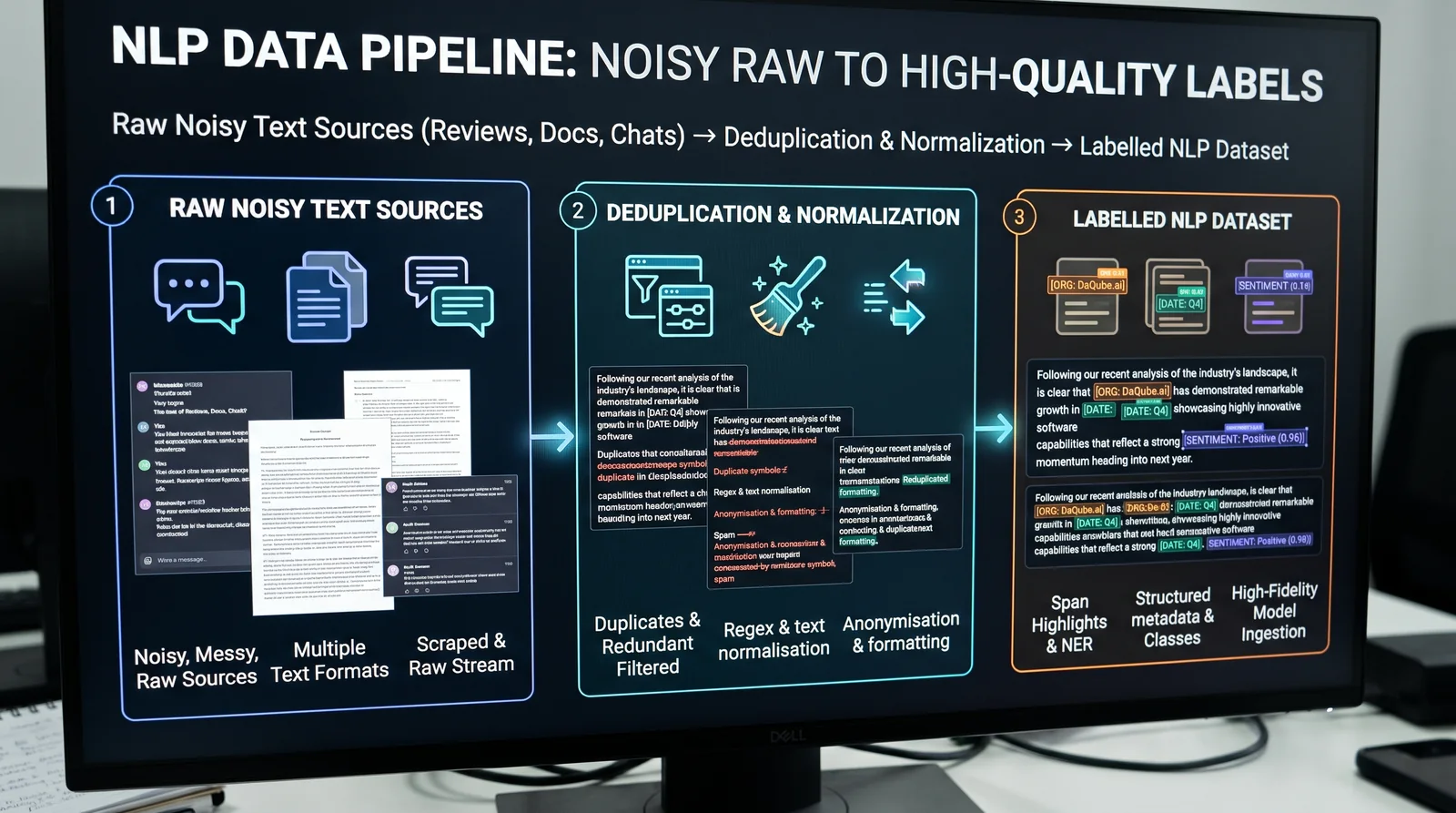
Text data comes from articles, business documents, customer reviews, social media posts, chat conversations, and product descriptions. However, raw text frequently contains duplicate entries, irrelevant noise, spelling issues, and inconsistent formatting. Without structured cleaning, sorting, organization, and task-specific labelling (sentiment, intent, named entities), language models fail to extract accurate insights or generate reliable responses.

Four Core Ways Text Data Trains Machine Learning Models
1. Helping AI Understand Human Language (Core NLP): Training models to understand word connections and sentence meaning for sentiment analysis, text classification, named entity recognition, translation, and question answering.
2. Understanding Customer Opinions & Feedback (Sentiment Analysis): Analysing thousands of reviews, surveys, and support chats to classify whether customers are happy, unhappy, or neutral and surface recurring product insights.
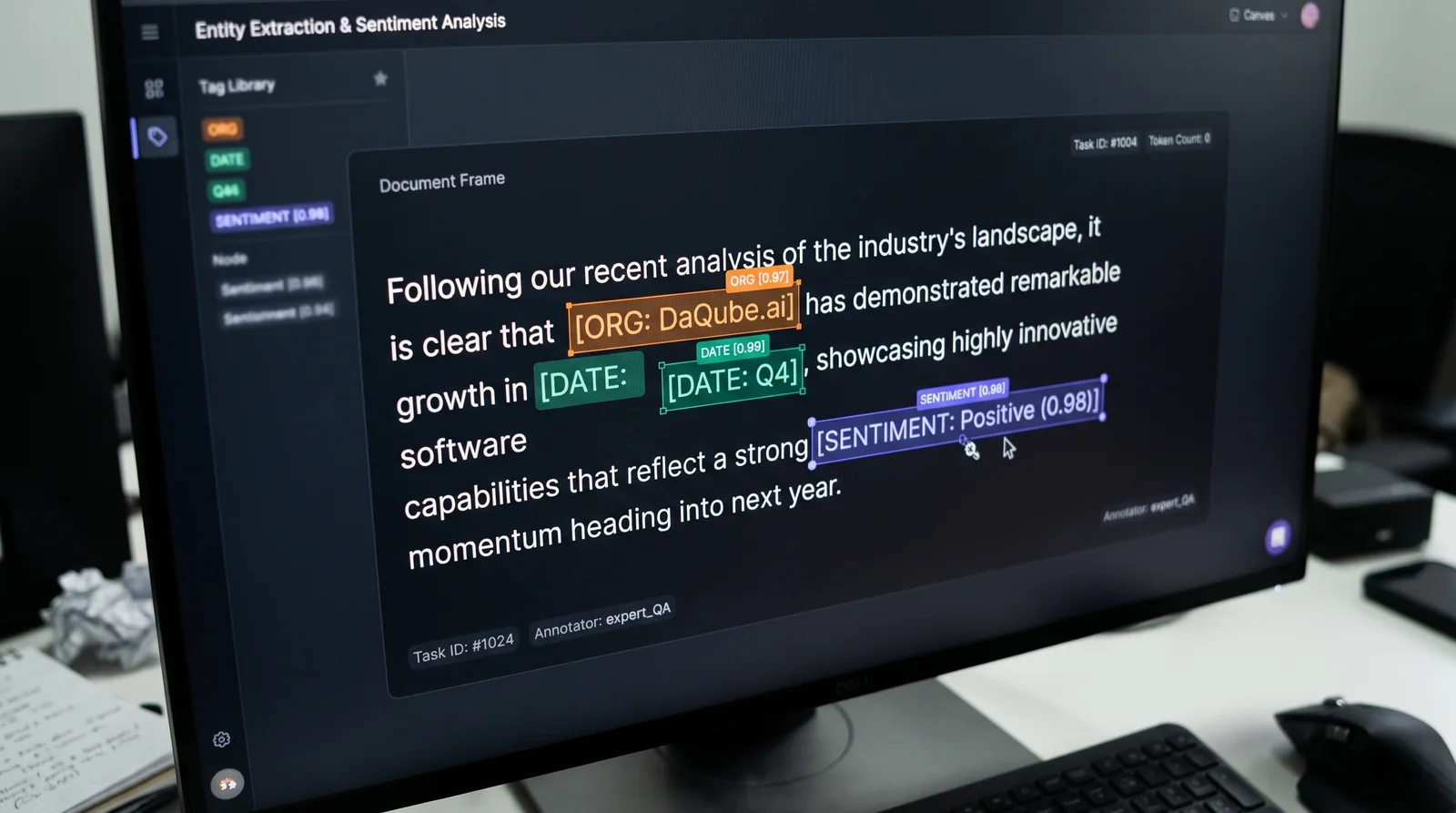
3. Finding Useful Information in Large Documents (NER & Extraction): Scanning reports and business documents to automatically identify company names, people, places, contact details, dates, and organizational relationships.
4. Helping AI Generate Human-Like Text: Training chatbots, AI writing tools, content assistants, and automated support agents to respond naturally to user questions and explain complex information.
NLP Task & Text Dataset Architecture Matrix
| NLP Application | Primary Text Source | Annotation & Preparation Required |
|---|---|---|
| Sentiment Analysis | Customer reviews, surveys, social posts | Positive / Negative / Neutral polarity & aspect labelling |
| Named Entity Recognition (NER) | Business documents, reports, articles | Span tagging for Names, Organizations, Dates, Locations |
| Conversational AI & Chatbots | Support messages, chat logs, Q&A pairs | Intent classification, dialogue turn cleaning & response pairing |
| Content Generation & Translation | Multilingual articles, summaries, web copy | Deduplication, spelling/grammar normalization & parallel alignment |
Why Choose DaQube.ai for Text Data Solutions?
Every AI project has distinct linguistic requirements: some need customer reviews, while others require multi-turn support conversations, financial documents, or domain-specific articles. DaQube.ai supports diverse text formats, performs text classification, sentiment labelling, and entity recognition, and removes duplicates, spelling issues, and formatting inconsistencies.
When ready-made datasets do not match your domain, we prepare custom text datasets structured around your exact model objective and expected output format.
Deterministic Milestones from Ingestion to Handoff
Requirement Discovery (Target NLP Task, Domain Sources & Formats)
Multi-Source Text Data Collection (Reviews, Docs, Chats, Articles)
Data Cleaning & Normalization (Deduplication, Spelling & Formatting)
Text Annotation & Labelling (Sentiment, Classification, Named Entities)
Custom Dataset Packaging & Delivery for ML / LLM Training
Acceptance Criteria and Quality Verification
Technical & Operational FAQs
What sources are commonly used in text data collection?+
Text data can be collected from articles, blogs, business documents and reports, customer reviews and feedback, social media posts and comments, chat conversations and support messages, and product descriptions.
Why is data cleaning necessary before training language models?+
Raw collected text often contains duplicate entries, irrelevant content, spelling issues, or inconsistent formatting. Cleaning and organising the text ensures the model learns accurate language patterns rather than noise.
What NLP tasks does DaQube.ai support with text annotation?+
We support sentiment analysis, text classification, named entity recognition (identifying names, places, dates, and organisations), language translation, question answering, and conversational chatbot training.
Ready to build your custom dataset with DaQube.ai?
Speak directly with our AI data solutions team to scope data collection, annotation guidelines, sample pilots, and delivery timelines.