Video Datasets for Human Activity Recognition: Collection, Labeling & Fit
How human activity recognition video datasets are designed, recorded, and temporally labeled: covering clip classification, start/end timestamps, pose keypoints, and dataset split hygiene.
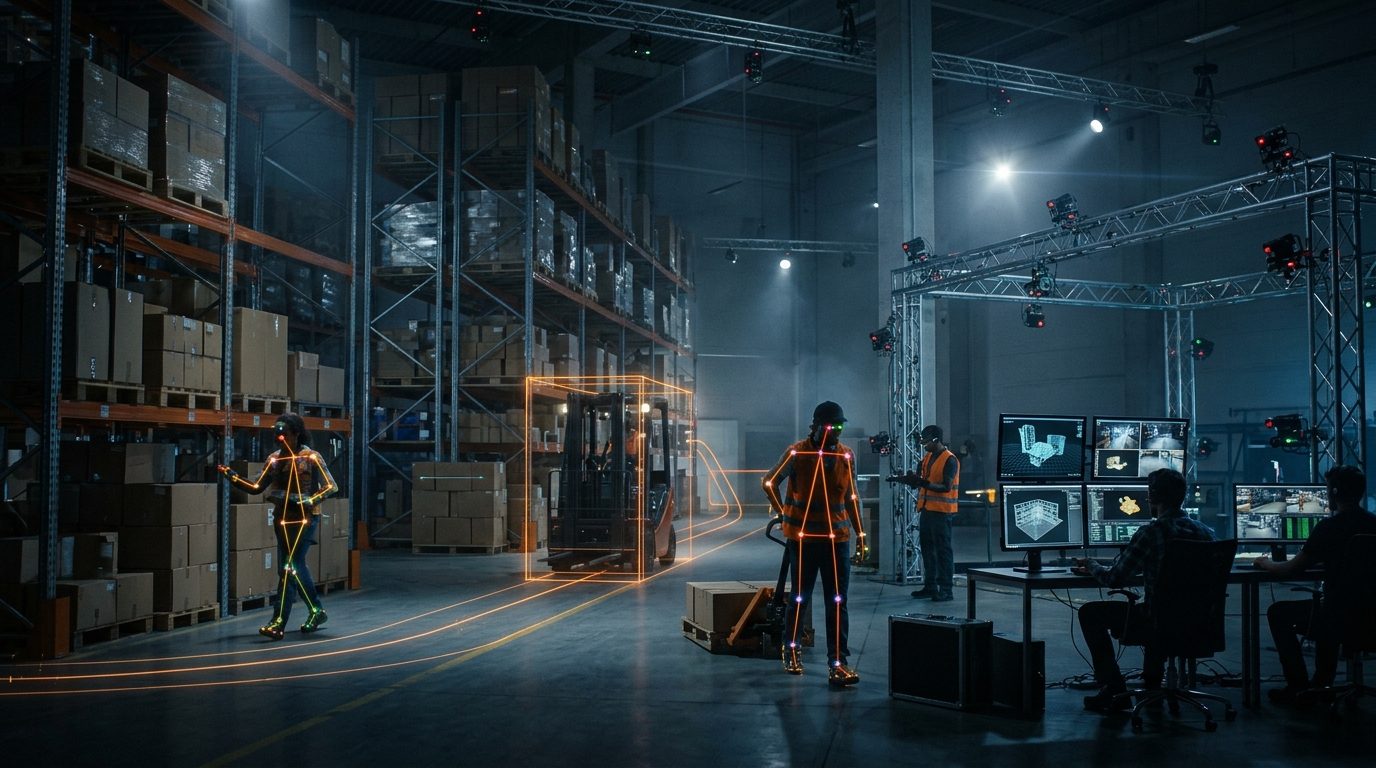
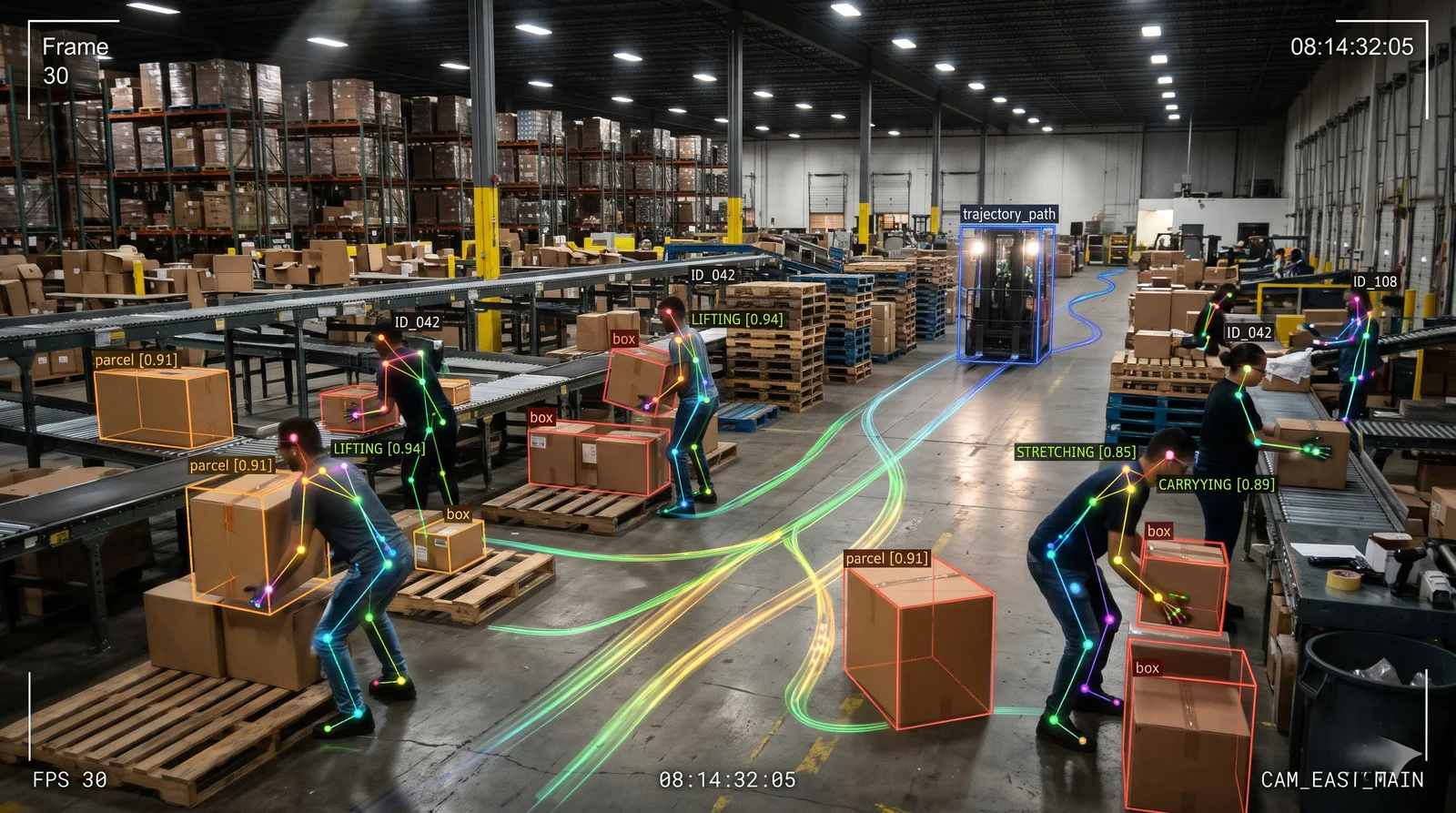
A person lifts a box, pauses, then sets it down. To recognize that sequence, a machine learning model needs more than a single static image: it needs examples of movement over time and structured labels that explain what is happening. Video datasets for human activity recognition bring those examples together: matching the exact actions, camera perspectives, and environmental conditions your model will encounter in deployment.
Planning a human activity recognition project? Share your target actions, environments, camera views, annotation types, volume, and timeline with DaQube.ai for a custom quotation.
Why Dataset Fit & Negative Examples Matter in Video AI
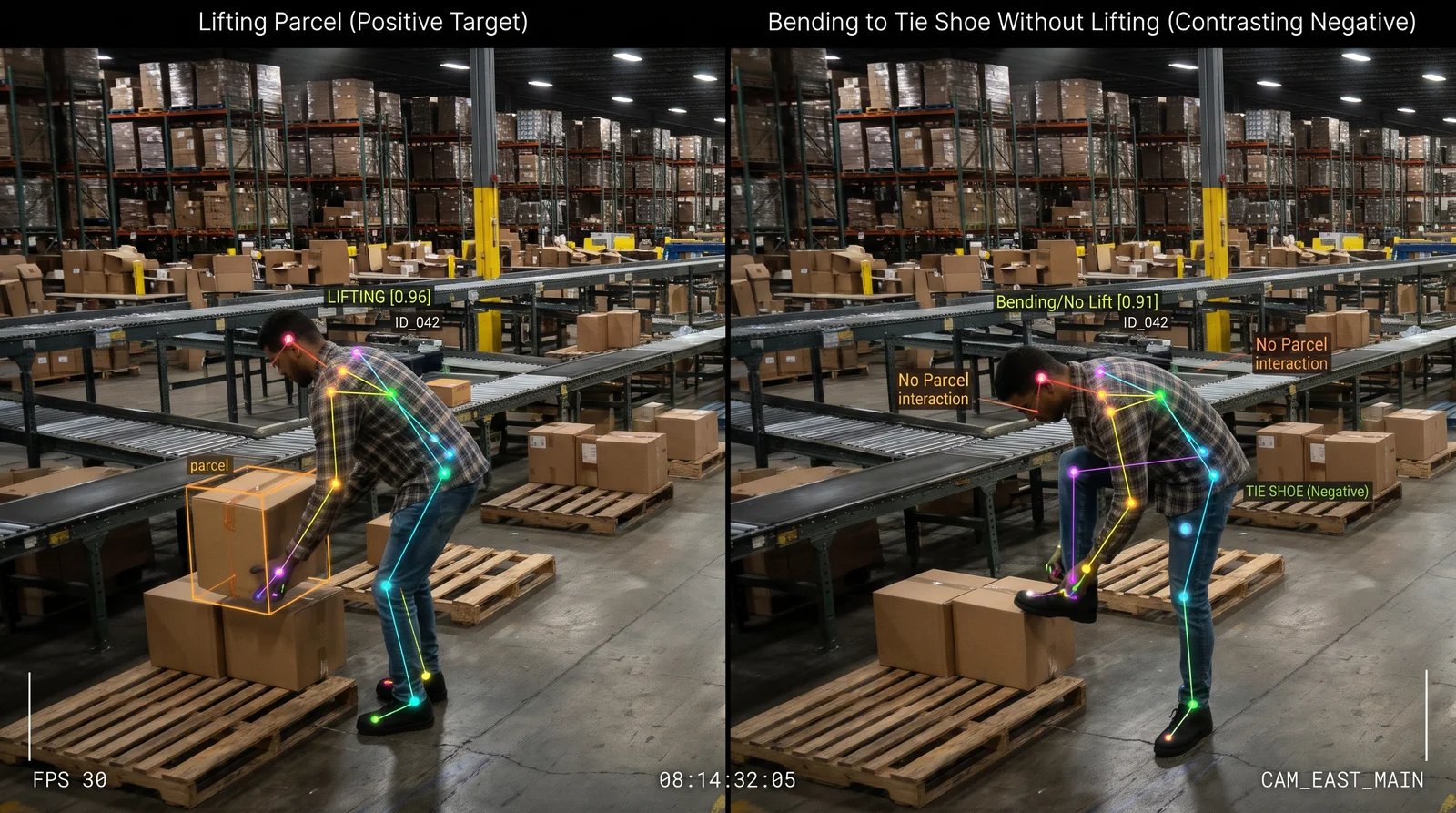
An action that looks obvious to a person can appear completely different to a model when the camera angle shifts or the view is partially blocked. Public video datasets rarely match specific deployment environments: for example, lifting a parcel in an industrial warehouse looks very different from lifting a small object at home. Models also fail without contrasting negative examples (such as bending down without lifting) and careful train/validation/test split grouping by participant or session to prevent data leakage.
How Activity Recognition Videos Are Collected, Labeled & Protected
Collection Brief & Camera Spec Design: Define target actions, environments, participant variation, camera perspectives, clip duration, frame rate (FPS), resolution, and file format based on motion detail.
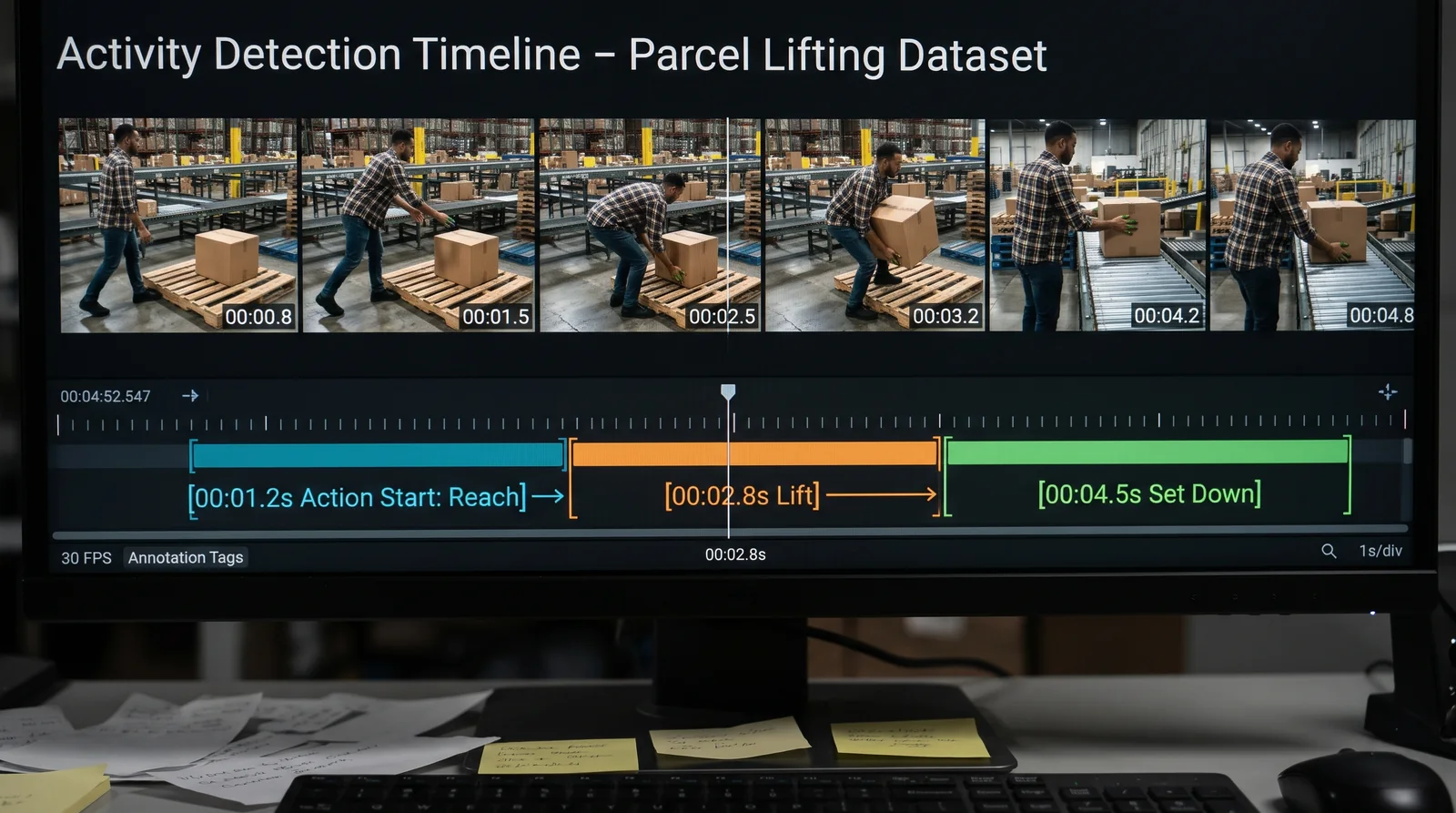
Annotation Guidelines & Pilot Calibration: Define what counts as an action, how to mark exact start/end timestamps, and how to handle overlapping or partially occluded movements: tested first via a short pilot.
Quality Assurance & Leakage-Free Splits: Review sampled clips, compare inter-annotator timestamp alignment, check class coverage, and group footage by participant or recording session across train/val/test splits.
Privacy, Consent & Usage Rights Governance: Establish informed participant consent, access controls, retention limits, and evaluate anonymization tradeoffs (such as face blurring vs. model utility) with legal advisers.
Activity Recognition Annotation & Application Matrix
| Annotation / Application | Technical Output | Operational Consideration |
|---|---|---|
| Action Classification | Clip-level activity category label | Best for pre-segmented short clips with single actions |
| Temporal Localization | Exact start & end timestamps in long video | Requires clear boundary rules for action onset/completion |
| Person Tracks & Keypoints | Bounding box trajectories + joint skeletons | Essential when multiple people appear or posture matters |
| Workplace / Sports / Care | Domain-specific movement & safety alerts | Group splits by participant/session to prevent data leakage |
Where Can Human Activity Recognition Be Used?
Possible applications include Workplace Safety (identifying defined movements for review, such as heavy lifting or entering a restricted zone), Sports Analysis (classifying movements in training footage to support coaching and video review), and Assisted Living (exploring detection of events such as falls, with human oversight and safeguards appropriate to the setting).
Each application requires its own definition of success: a model used to assist a human reviewer should be evaluated differently from one used to trigger an automated alert.
Deterministic Milestones from Ingestion to Handoff
Author Collection Brief (Actions, Camera Angles, FPS, Negative Cases)
Establish Consent, Privacy Permissions & Recording Protocols
Draft Timestamp & Occlusion Guidelines + Run Short Labeling Pilot
Execute Temporal & Keypoint Annotation with Alignment QA Audits
Partition Leakage-Free Participant Splits (Train / Validation / Test)
Acceptance Criteria and Quality Verification
Technical & Operational FAQs
What is the difference between action classification and localization?+
Action classification identifies an activity across an entire clip. Temporal localization also identifies exactly when an activity starts and ends within a longer video. Your annotation requirements depend on which output your model needs.
How many videos are needed to train a human activity recognition model?+
There is no universal number. It depends on the task, variation in the footage, label quality, and the model and data already available. A pilot and evaluation on held-out footage can help guide further collection.
Can an existing video dataset be used commercially?+
Possibly, but check the specific license, participant permissions, and any restrictions on the source footage. Public availability alone does not establish permission for commercial training or redistribution.
Ready to build your custom dataset with DaQube.ai?
Speak directly with our AI data solutions team to scope data collection, annotation guidelines, sample pilots, and delivery timelines.