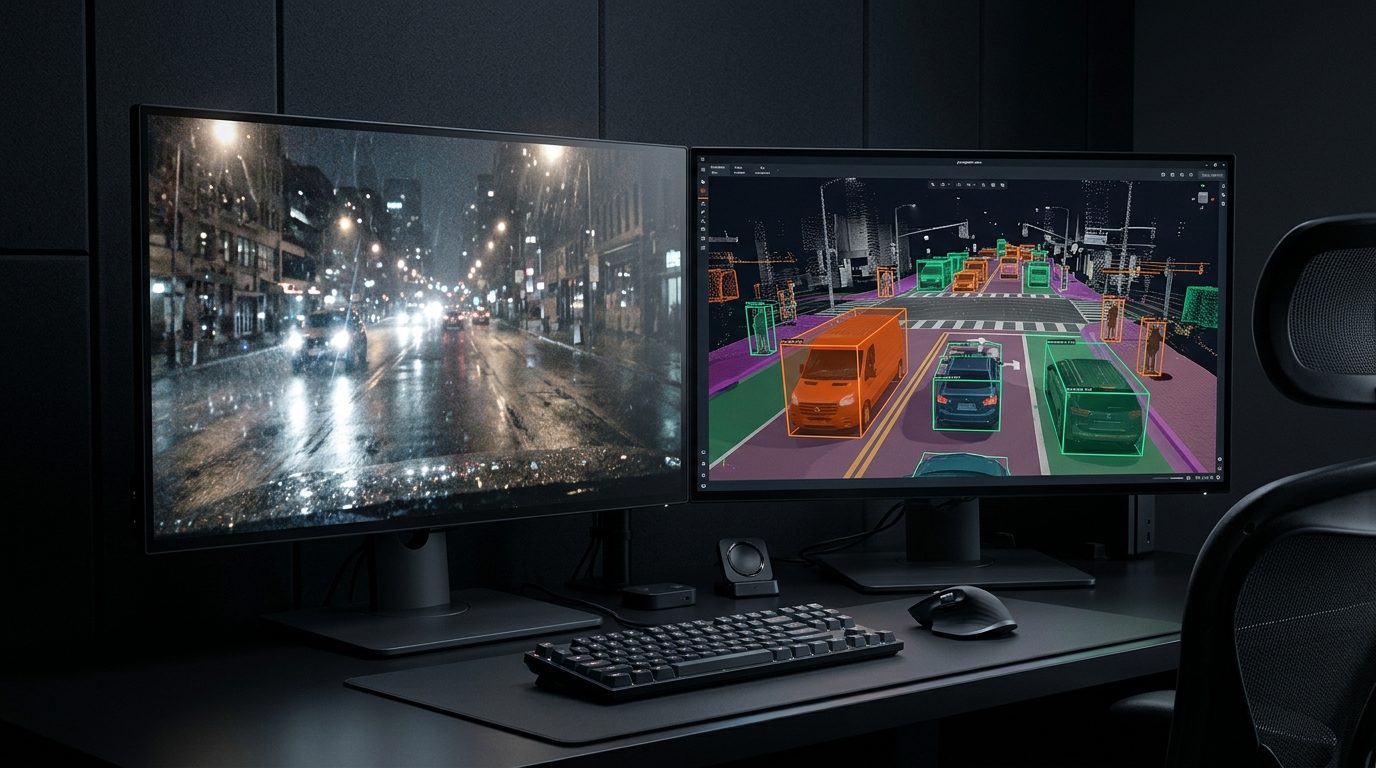
Image and video annotation is a core foundation of training AI and computer vision models. It involves adding structured labels, tags, and spatial boundaries to images and multi-frame videos so machines can recognise people, vehicles, products, animals, and dynamic movements across manufacturing, retail, healthcare, agriculture, and transportation.
Why Quality Annotation Matters for Model Performance
The performance of any computer vision model depends directly on the quality and consistency of its training labels. Incorrect, loose, or inconsistent annotations across frames confuse object detectors and degrade model accuracy. High-performing visual AI requires clear annotation guidelines, method selection matched to the exact task (boxes vs. pixel masks vs. skeletal keypoints), and continuous quality review.
1. Object Detection & Bounding Box Annotation (People, cars, products, animals)
2. Semantic Segmentation (Pixel-level category assignment: roads, buildings, trees, vehicles)
3. Instance Segmentation (Separating individual overlapping objects of the same class, e.g., 5 distinct cars)
4. Keypoint Annotation (Facial features, body joints, hand positions, pose landmarks)
5. Action Recognition & Video Annotation (Tracking walking, running, jumping, lifting, machinery operation across frames)
Five Core Image & Video Annotation Methodologies
Object Detection and Bounding Box Annotation: Identifying target objects in images or video frames and enclosing them in tight boxes with class labels (person, car, product, animal) for reliable detection.
Semantic Segmentation: Assigning a category label to every single pixel in an image or video frame: separating roads, buildings, trees, vehicles, and people for full-scene understanding.
Instance Segmentation: Going a step further by identifying and separating each individual object even when multiple objects share the same category (such as five overlapping cars in traffic).
Keypoint & Action Recognition Annotation: Marking anatomical landmarks (facial features, body joints, hand positions) for pose/gesture estimation, and labelling continuous activities (walking, lifting, operating machinery) across video frames.
Quality Assurance & Guideline Discipline at DaQube.ai
At DaQube.ai, we focus on providing accurate and consistent annotated data based on each project's specific requirements. Our workflow includes following clear annotation guidelines, reviewing completed batches, and verifying labels to maintain quality throughout the lifecycle.
Whether you need object detection, image classification, video tracking, pixel segmentation, or activity recognition, we deliver well-organised datasets across manufacturing, retail, healthcare, agriculture, and transportation.